“No recovery here”

One of the really interesting outcomes of the last election was the rejection by voters of the Fine Gael strap line: let’s keep the recovery going. As measured by GDP growth, Ireland was rebounding from its period of austerity very strongly, with the fastest GDP growth in Europe.

A household sector which had just received an income tax cut, child benefit increases, pension increases, social welfare increases, public sector pay increases (or restorations, whatever), threw the main party’s ‘recovery’ line back in its face at the doorsteps–what recovery, they asked. No recovery here.

This was taken to mean that there was no recovery outside of Dublin. Dan O’Brien’s series of columns have dispelled that myth. There is a recovery in rural Ireland, it’s just not happening as quickly as in the capital, where employment levels are now 96% of their 2008 peak. In the Mid-West employment levels are at 88% of their peak.

Source: CSO.ie
Source: CSO.ie

Then a long and rambling discussion on the corporate tax element of Ireland’s apparent rebound took place, largely on twitter. The volatility of the corporate tax take in Ireland is exceptional.

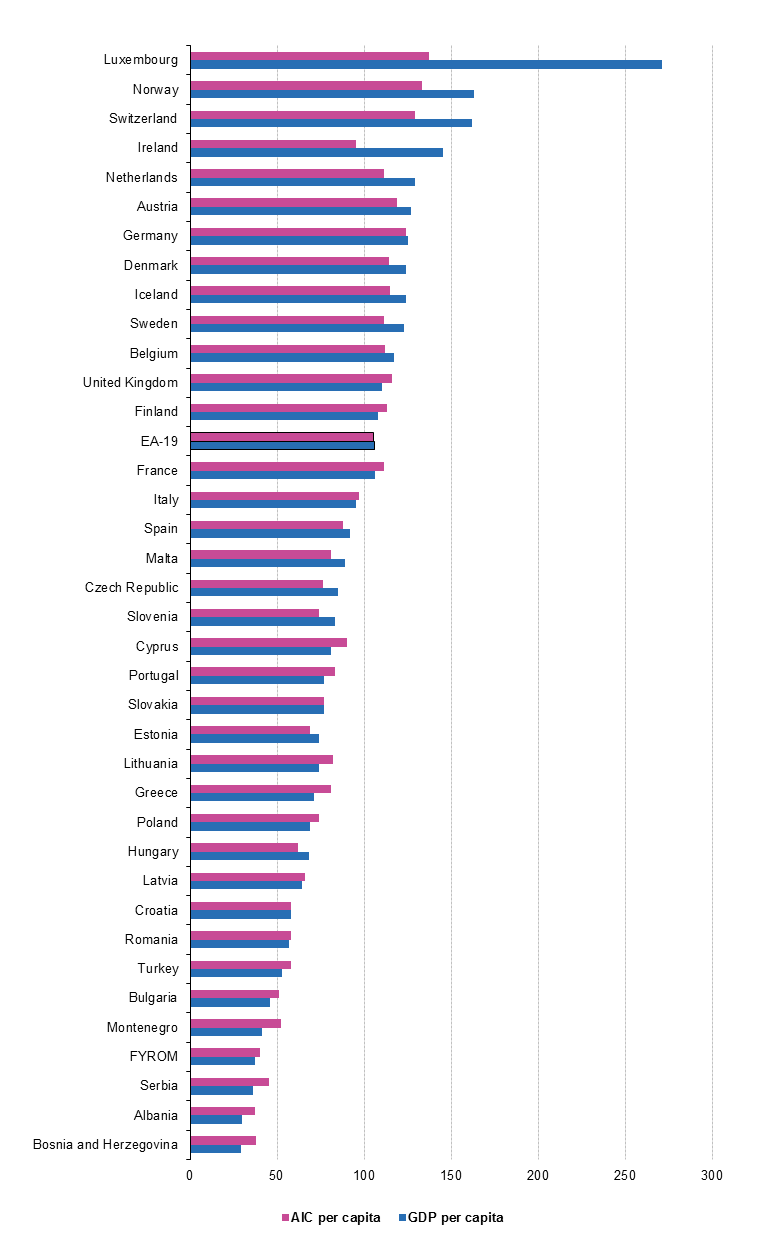
Yet another strand of the argument is given by thinking about Ireland in relation to Europe. Philip Connolly of the times in Ireland showed me these data of GDP per capita in purchasing power parity adjusted euros compare it with an actual income for consumption measure. The graph below is from Eurostat and shows the difference in the two measures  with Ireland and Luxemburg showing a very large difference between these two measures of household welfare. Using the AIC measure, Irish households are closer to Italian than Danish levels of welfare.
Source: Eurostat
Source: Eurostat

This may give a clue as to why we see such large differences between official rhetoric and the popular reaction to that rhetoric.


Reforming Ireland’s Budgetary Cycle

Via Commenter @DOCM:

The final report of the Oireachtas sub-committe on reform is now available here.

It represents a major, even historical, change, including the introduction by 2017 of an IPBO, which we discussed here.

There remain, however, a number of major ambiguities e.g. no definition of the “budgetary cycle”, lack of clarity in the role of the Budget Oversight Committee (BOC) and its relations ship with the the sectoral committee “shadowing” Finance, PER and the Taoiseach’s department and, in particular, the other sectoral committees (page 9) “Committee also to consider option where Departmental Estimates would be considered by sectoral committees which would make their views known to Budget Oversight Committee for its consideration of aggregate position.”

In short, plenty on the form but very little in the matter of the substance of the involvement of the Dáil in deciding the levels and allocation of expenditure and taxation. It seems. however, that the split between PER and Finance will be between these two issues cf. the remarks by the Minister of Finance:

“The Spring Economic Statement will become a summer statement and it should be ready by June. There will be a full debate in the House. I am providing all the text papers to the finance committee so that there will be a full debate on taxation at that point, in advance of the budget.”

Tax havens ‘serve no useful economic purpose’

Several of this blog’s commentators have signed the letter calling for an end to tax havens, details of the letter itself, and the full list of signatories, are here.

I’d welcome commenters’ thoughts on the issue of tax havens (not just in an Irish context, of course).