Olli Rehn in the FT

Olli Rehn has an interesting piece in the FT this morning.   One noteworthy part is the admission that the current and proposed financial support measures are not up to the task.

In parallel, we must ensure that the financial support mechanisms put in place last May are fit for purpose. The effective lending capacity of the current European financial stability facility should be reinforced and the scope of its activity widened. Here we need to review all options for the size and scope of our financial backstops – not only for the current ones, but also for the permanent European stability mechanism too.

Argued the Case for Default?

Someone called Maeve Sheehan has a piece in today’s Sunday Independent describing how I appear in Department of Finance Secretary General Kevin Cardiff’s diary as giving a seminar at the Department. I did give such a seminar, on September 17.

Ms. Sheehan describes me as follows “Professor Karl Whelan, another UCD economist, who has argued the case for default.”

I am genuinely unsure what Ms. Sheehan is referring to here. But I thought I’d use this forum to clarify that I have never advocated default on Irish sovereign debt. In addition, I have only ever discussed the idea of bank bonds being defaulted on in the context of legal provisions that allow for such defaults when a bank is insolvent or in the context of internationally-accepted special resolution regimes, which allow for an orderly approach to dealing with bank creditors when a bank is insolvent and which generally contain many protections for such creditors.

Also, because the above sentence could be radically misunderstood if one made the easy mistake of missing the word “has”, I would also like to clarify that at no point during my seminar at the Department of Finance on September 17 did I advocate default on either sovereign or bank bonds.

Scrapping the Seanad is a Big Political Reform

Since the emergence at the weekend of unanimity amongst political parties that the Seanad should go, contrarian commentators have been forced to argue that this is not a ‘real’ political reform, what we need is fundamental change, etc etc.

The move to a unicameral parliament is a pretty big change, and for the better. This is what I wrote for today’s Farmers Journal.


The decision of the Labour Party to support Fine Gael’s plan to scrap the Seanad pretty much seals the fate of Ireland’s experiment with a two-chamber parliamentary system. Fianna Fail and the Greens have also, however belatedly, come to the same conclusion, and all the main political parties are now signed up to this particular political reform. The Seanad costs around €25 million per annum directly, and An Bord Snip suggested, in July 2009, that its time was up. The direct saving however is not the full cost of the second chamber.

Civil servants spend a considerable amount of time dealing with queries (they call them ‘reps’, short for representations) from Senators, many of whom see themselves as trainee TDs and engage in clinics and general messenger services for voters in whatever constituency they have their eye on. Ministers must attend the Seanad regularly in addition to making themselves available for questioning in the Dail. This eats into the time ministers can devote to running the country, and while Dail accountability is essential, the demands of the Seanad on ministerial diaries is substantial and very hard to justify. I recall spending several hours with senior officials some years back waiting for a minister detained in the Seanad who apologised profusely and predicted, quite accurately, that not a syllable of the Seanad proceedings which detained him would make it into the parliamentary reports in the newspapers the following day. In addition to the direct saving of €25 million per annum, there should be further savings in civil service personnel and a reduction in the time-wasting demands on ministers.

Under the current Irish system, we have 166 TDs and 60 Senators, for a total of 226 national parliamentarians. This is rather a lot for a small country, and most countries of our size make do with a single-chamber parliament. The public seem quite happy to let the Seanad go and there have also been calls for a reduction in the number of TDs. Bord Snip did not feel that a major reduction in the size of the Dail was advisable, although the number does not have to be 166. Cutting numbers saves only the direct costs: scrapping the second chamber in its entirety provides opportunities to make all sorts of indirect savings as well.

There have been numerous distinguished Seanad members over the years, including some of those elected from the university panels. But there have also been legions of defeated TDs and wannabe TDs, leading one wag to describe the Seanad as a mixture of creche and retirement home. There is nothing to stop the better class of senator to welcome the inevitable and run for the Dail. I can think of a few I might even vote for! But the occasional emergence of good contributors in the Seanad cannot conceal the overall mediocrity that has been its hallmark. The Irish Times managed to disagree with itself last weekend on the following crucial issue: how many reports have been prepared over the years (the first was in 1928) on the reform of the Seanad? Harry McGee thinks there have been twelve, Noel Whelan plumped for thirteen. I recall, as a student in the late 1960s, attending a discussion group called Tuarim, whose leading lights included Tom Barrington, Barry Desmond and Garret FitzGerald. One spirited debate was about , you guessed it, reforming the Seanad. Any institution still searching for a meaningful role seventy four years after its re-creation in current form needs to be scrapped.  

Of course scrapping the Seanad is not a political reform programme on its own. It is essential that the Dail becomes a more effective chamber and that a better balance be restored between executive and legislative branches of government. But scrapping the Seanad will help both directly and indirectly. Those with ambitions to serve in national politics will now have no option but to shoot for the Dail, which should make that a better chamber. The politicians need to restore credibility as a group, and the public will see abolition as evidence of serious intent to reform, at the cost of some cushy numbers for the political class. This will help when the time comes to face the music on local government reform, through eliminating the excessive number of local councils, and on reforming the public service, where numerous useless quangoes survive.  

Estonia Joins the Euro Area

Estonia has now joined the euro area (10pm Irish time is New Year in Estonia) – over the years, it will be interesting to see the difference it makes in shifting from a ‘hard peg’ to the euro to full membership of the euro area.

“Global warming linked to harsh winters”

This headline appeared in the Irish Times on 20th December 2010. In the article that followed Frank McDonald admitted this was “paradoxical” but explained that recent research has linked severe winters in northern Europe to diminishing levels of ice in the Arctic sea. A more detailed account of the same reasoning is contained in this article published in the New York Times on December 26th 2010.

This new view of the effects of global warming is quite an about-turn.

In 2009 the Irish Environmental Protection Agency (EPA) published a Summary of the State of Knowledge on Climate Change Impacts for Ireland. This document provides predictions for key climatic variables for the rest of 21st century based on extrapolations of observed changes relative to the 1961-1991 averages. Here is how some key trends are summarized in Tables 2.1, 2.2, and 2.7.

“All seasons are warmer but more so in winter”

“Less frost; trend of decreasing frost nights and decrease in duration.”

“Less (sic) snow days”.

“Increases in Irish coastal water temperatures”.

“Drier summers”

All but the last of these generalizations were made with a “high degree of scientific confidence”. The deluges of the summers of 2007, 2008, and 2009 reduced the confidence attached to the last point to “medium”.

If instead of the the recent extreme weather events there had been comparable deviations in the other direction (dry, hot summers and mild, snow-less winters) confirmation bias would have led many commentators to view such events as strong support for the predictions contained in the EPA document. The same bias now leads commentators to label the actual recent pattern of extreme events “anomalies” and to offer ad hoc explanations for them. One has to wonder about a science that flip-flops from predicting one extreme to the other in so short a space of time. If climatologists are now saying that our winters may be  going to get colder rather than warmer, it will be very hard to test the various hypotheses associated with the idea of “global” warming.

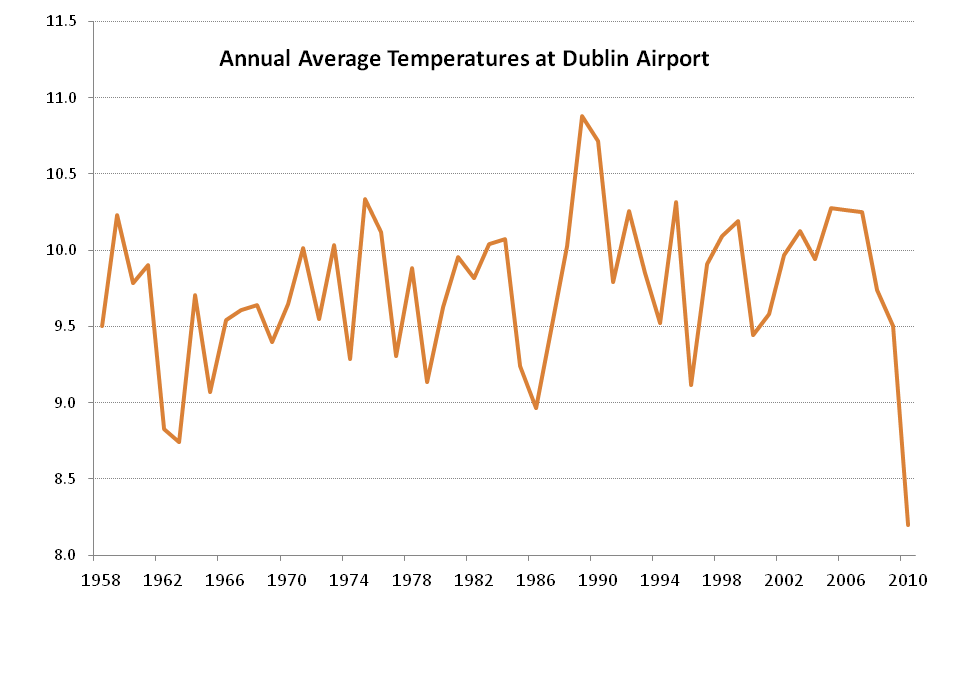
A longer term perspective is needed if we are to talk about “climate” as opposed to “weather”. In an earlier post I drew attention to absence of a positive trend in the Dublin’s annual average temperature over the period 1958 to 2008.  Two more years of data have reinforced the main points I made in that contribution. In 2009 Dublin’s temperature was slightly below the long-term average, while 2010 was the coldest of the past 52 years, with an average temperature of 8.3º C – more than two standard deviations below the 1961-1991 average used by meteorologists to represent “the long run”. During last winter (December 2009 – February 2010) the average temperature was three standard deviations below the long-run winter average. It is very likely the winter of December 2010 – February 2011 will also be unusually cold.

However, it would be a mistake to believe that the recent downward trend in annual temperatures is due only to colder winters.  June and July were the only months of 2010 when Dublin temperatures were above their long-run averages.  The warmest year of the past half century was in 1989. The average temperature during the naughties was lower than during the 1990s

A longer term perspective is needed if we are to talk about “climate” as opposed to “weather”. The graph of Dublin’s annual average temperatures (below) does not convey an impression of a consistent upward trend in annual temperature since 1958. This is confirmed by standard statistical tests, which reveal that there has not been a significant trend (positive or negative) in the annual data over the entire 52-year period.  Nor has there been a consistent trend in temperature in any of the four seasons. More detailed investigation shows that there was a significant positive trend for some 30-year windows between 1958 and 1993, but for all such windows between 1971 and 2010 the trend has been negative although not statistically significant. The trend in Winter and Summer temperatures has been negative but not significant since the 1970s. Similar graphs of Dublin’s rainfall reveal no significant trends.

The fairest summary of this evidence would seem to be that Dublin’s climate has not changed significantly over the past half century.
The evidence for an upward trend in temperatures over the past half century is stronger for weather stations outside Dublin. Dublin has become colder than other parts of Ireland.  Belmullet, for example, shows strong evidence of a positive temperature trend for much of the period and the Dublin minus Belmullet differential widened markedly in the 1990s. But here, too, there is a puzzle: Belmullet’s temperature showed no positive trend between 1958 and the mid-1980s but for the next twenty years there was a strong positive trend, while the last three years have been cooling again.  Here, as for the other stations, the volatility of the data is very striking.

These small pieces of evidence may, of course, be dismissed as irrelevant to the “global warming” debate. But to adapt Tip O’Neill’s aphorism, all climate is local. The Dublin data draw attention to the fragility of some of the evidence on which recent predictions of climate change have been based.

Happy New Year!