Debt forgiveness, one more time.

This Irish Times article reports Morgan Kelly’s keynote ISNE lecture where he discussed debt forgiveness and, in particular, mortgage debt relief. From the piece:

“We are talking sums in the region of €5 billion to €6 billion which would be necessary to spend on mortgage forgiveness, which by our standards are not very large,” he said.

“This sum to sort out tens of thousands of people with big problems does not seem enormous.”

Seamus Coffey has some thoughts on Prof Kelly’s argument here.

Readers should know I’m in favour of debt forgiveness for households, and have been for some time. It may be worth discussing the pros and cons of such a policy again.

Update: Jagdip has some thoughts on this debate on NamaWineLake.

Results of the smart meter trial

There’s a peculiar piece in today’s Independent. The reports of the CER’s 18 month smart meter trial were published in May.

The trial found statistically and economically significant changes in consumer behaviour due to the introduction of time-of-day pricing, with cost savings for both producers and consumers that together more than offset the costs of metering (unless the wrong communication network is chosen).

The trial also found that in-house displays further modify electricity use, but insufficiently so to justify the additional cost.

Real-time pricing was not trialed, nor were smart devices, micro-generation, electric vehicles, and micro-storage.

External Adjustment and the Global Crisis

Readers may be interested in this new research paper that looks at current account adjustment over 2008-2010.

Summary: After widening substantially in the period preceding the global financial crisis, current account imbalances across the world have contracted to a significant extent. This paper analyzes the factors underlying this process of external adjustment. It finds that countries whose pre-crisis current account balances were in excess of what could be explained by economic fundamentals have experienced the largest contractions in their external balance. External adjustment in deficit countries was achieved primarily through demand compression, rather than expenditure switching. Changes in other investment flows were the main channel of financial account adjustment, with official external assistance and ECB liquidity cushioning the exit of private capital flows for some countries.

Ireland’s Atlantic Oil & Gas

Minister Rabbitte responds to an earlier piece by Fintan O’Toole in today’s Irish Times.

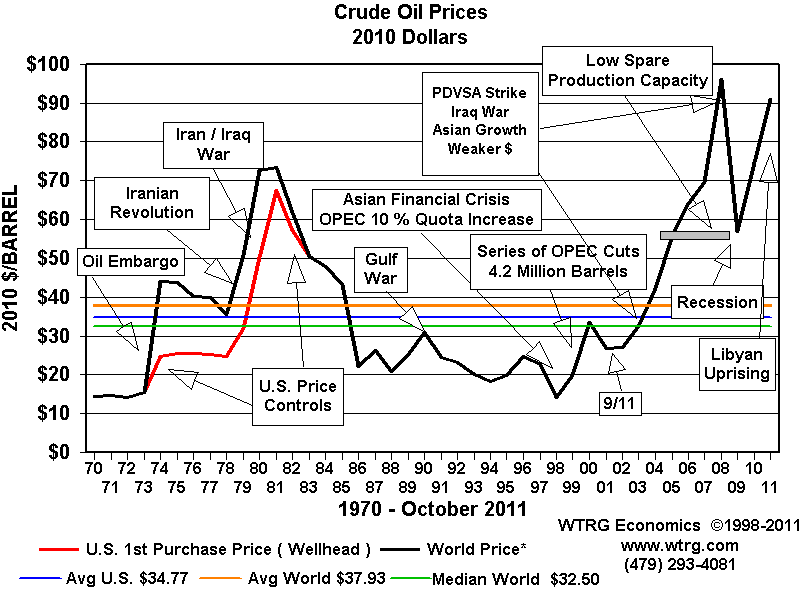
It may well be that there are large amounts of oil and gas off Ireland’s west coast. It may well be that, after rapid advances in exploration and exploitation technology, these fields can be developed commercially. That would boost the Irish economy in 15 years time or so.

None of that is certain. It is clear, however, that oil and gas exploration companies have renewed their interest in the Irish part of the Atlantic. The assessment of the 1970s showed that the Irish resources are hard to develop. 20 years of low oil prices and, more recently, the Corrib controversy did not help. But with the current high oil price, the success off Brazil and the promise off Angola, the Irish Atlantic is back into the picture.

This is good news. However, Mr O’Toole and Mary Lou McDonald TD seem to want to kill the goose before it has laid its first egg, perhaps golden. I agree with the Minister. No oil or gas has been struck and this is not the right time to spook companies with talk of high taxes and nationalization.

Leaving Cert Results

Here is a quick look at the overall Leaving Cert performance of students taking Economics in the Leaving Cert.  Just over 8% of Leaving Cert students took Economics as a subject.

This year around 3,700 took the Higher Level Paper and it can be seen that the distribution of marks was consistent with the previous two years.    There were 1,063 candidates for the Ordinary Level Paper.

A breakdown of the marks for all 34 Leaving Cert subjects can be seen here.

There were no candidates for Ancient Greek and Hebrew Studies. Of the papers that were taken the lowest number of candidates was the 32 who sat the Higher Level Agricultural Economics paper.  The most attempted paper was the Ordinary Level Maths paper with 37,505 candidates.

The number of students that took the Higher Level Maths Paper did indeed set a record low as was previously discussed here.