First estimates of the costs of the climate bill

As another sign of the rushed introduction of the climate bill, the first estimates of the costs of the climate bill are published in a newspaper. O Gallachoir’s estimates are based on a model which is still under active development (rather than on a model which has been vetted and peer-reviewed — this is due to the starting date of the modelling project). Note that UCC is way ahead of the ESRI here: We still have to figure out how to estimate the economic impacts of targets this deep; the measures included in our model are not sufficient. The regulatory impact assessment has no cost estimates.

So, we are essentially asked to sign up to something we do not understand.

UPDATE: The IFA argues, rightly, that it is peculiar to introduce the climate bill next Wednesday when the public consultation is still ongoing. This reminds me of the waste bill, also imminent, for which the results of consultation are still not made public. Which is the party again that “believe[s] […] in a political system that is transparent“? (Hint: click the link.)

Poolbeg again

In the Netherlands, if a government falls, it continues on as a caretaker government until the new government is formed. Any member of parliament can declare as controversial a particular piece of legislation and regulation, and the caretaker government cannot make any decisions on these subjects. If it tries nonetheless, the senate will block this — and if it doesn’t, the queen will.

Ireland is different. Just prior to electoral defeat, a number of initiatives are being rushed through. There should be checks and balances to prevent this sort of thing. I’ll return to the climate bill later this week.

Poolbeg is back in the news. Although the public consultation on waste policy is still so recent that the department has yet to publish the submissions (at least one of which raised fairly fundamental concerns), if the Irish Times is to believed, new legislation will be introduced this month that would give the Minister of the Environment the power to set punitive levies on incineration and landfill.

Instead, waste levies should reflect the externalities of waste disposal. The maximum incineration levy is much higher than the two available estimates of the external cost of incineration.

The draft waste policy was far from ready. Instead of rushing through immature legislation, the government should have the grace to pass this dossier to the next government. ATMs will continue to work.

UPDATE: The story heats up again. See Times, Independent, and Independent again (with a reference to the EER2010).

UPDATE2: The Times claims that the bill will be published today (Jan 7). At 8.44 am, the submissions to the public consultation are still not online.

“Global warming linked to harsh winters”

This headline appeared in the Irish Times on 20th December 2010. In the article that followed Frank McDonald admitted this was “paradoxical” but explained that recent research has linked severe winters in northern Europe to diminishing levels of ice in the Arctic sea. A more detailed account of the same reasoning is contained in this article published in the New York Times on December 26th 2010.

This new view of the effects of global warming is quite an about-turn.

In 2009 the Irish Environmental Protection Agency (EPA) published a Summary of the State of Knowledge on Climate Change Impacts for Ireland. This document provides predictions for key climatic variables for the rest of 21st century based on extrapolations of observed changes relative to the 1961-1991 averages. Here is how some key trends are summarized in Tables 2.1, 2.2, and 2.7.

“All seasons are warmer but more so in winter”

“Less frost; trend of decreasing frost nights and decrease in duration.”

“Less (sic) snow days”.

“Increases in Irish coastal water temperatures”.

“Drier summers”

All but the last of these generalizations were made with a “high degree of scientific confidence”. The deluges of the summers of 2007, 2008, and 2009 reduced the confidence attached to the last point to “medium”.

If instead of the the recent extreme weather events there had been comparable deviations in the other direction (dry, hot summers and mild, snow-less winters) confirmation bias would have led many commentators to view such events as strong support for the predictions contained in the EPA document. The same bias now leads commentators to label the actual recent pattern of extreme events “anomalies” and to offer ad hoc explanations for them. One has to wonder about a science that flip-flops from predicting one extreme to the other in so short a space of time. If climatologists are now saying that our winters may be  going to get colder rather than warmer, it will be very hard to test the various hypotheses associated with the idea of “global” warming.

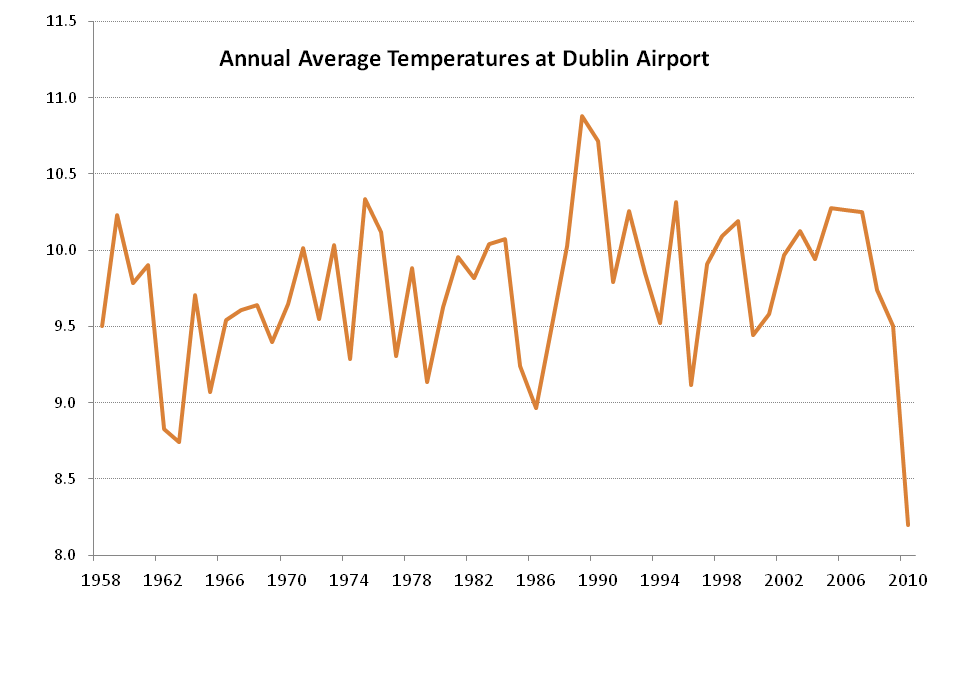
A longer term perspective is needed if we are to talk about “climate” as opposed to “weather”. In an earlier post I drew attention to absence of a positive trend in the Dublin’s annual average temperature over the period 1958 to 2008.  Two more years of data have reinforced the main points I made in that contribution. In 2009 Dublin’s temperature was slightly below the long-term average, while 2010 was the coldest of the past 52 years, with an average temperature of 8.3º C – more than two standard deviations below the 1961-1991 average used by meteorologists to represent “the long run”. During last winter (December 2009 – February 2010) the average temperature was three standard deviations below the long-run winter average. It is very likely the winter of December 2010 – February 2011 will also be unusually cold.

However, it would be a mistake to believe that the recent downward trend in annual temperatures is due only to colder winters.  June and July were the only months of 2010 when Dublin temperatures were above their long-run averages.  The warmest year of the past half century was in 1989. The average temperature during the naughties was lower than during the 1990s

A longer term perspective is needed if we are to talk about “climate” as opposed to “weather”. The graph of Dublin’s annual average temperatures (below) does not convey an impression of a consistent upward trend in annual temperature since 1958. This is confirmed by standard statistical tests, which reveal that there has not been a significant trend (positive or negative) in the annual data over the entire 52-year period.  Nor has there been a consistent trend in temperature in any of the four seasons. More detailed investigation shows that there was a significant positive trend for some 30-year windows between 1958 and 1993, but for all such windows between 1971 and 2010 the trend has been negative although not statistically significant. The trend in Winter and Summer temperatures has been negative but not significant since the 1970s. Similar graphs of Dublin’s rainfall reveal no significant trends.

The fairest summary of this evidence would seem to be that Dublin’s climate has not changed significantly over the past half century.
The evidence for an upward trend in temperatures over the past half century is stronger for weather stations outside Dublin. Dublin has become colder than other parts of Ireland.  Belmullet, for example, shows strong evidence of a positive temperature trend for much of the period and the Dublin minus Belmullet differential widened markedly in the 1990s. But here, too, there is a puzzle: Belmullet’s temperature showed no positive trend between 1958 and the mid-1980s but for the next twenty years there was a strong positive trend, while the last three years have been cooling again.  Here, as for the other stations, the volatility of the data is very striking.

These small pieces of evidence may, of course, be dismissed as irrelevant to the “global warming” debate. But to adapt Tip O’Neill’s aphorism, all climate is local. The Dublin data draw attention to the fragility of some of the evidence on which recent predictions of climate change have been based.

Happy New Year!

Climate Change Response Bill 2010

The Climate Change Response Bill 2010 was published today for consultation, together with an explanatory memorandum.

Art 1-3 are preliminaries. Art 4 has the emission reduction targets:

  • Emission reduction should be 2.5% per year on average between 2008 and 2020. The bill seems to say that 2020 emissions should be 28% below 2007 emissions (i.e., 52 mln tCO2eq). The memorandum says that 2020 emissions should be 26% below 2008 emissions (i.e., 50 mln tCO2eq).
  • 2030 emissions should be 40% below 1990 emissions.
  • 2050 emissions should be 80% below 1990 emissions.

(In fact, the base year is 1995 for the F-gases and 1990 for the other greenhouse gases. Between 1990 and 1995, emissions of F-gases rose from 0.06 mln tCO2eq to 0.20 mln tCO2eq so the dual base year just complicates things.)

The 2030 target seems to follow from the fact that 2030 is halfway between 2010 and 2050 and 40% is halfway between 0% and 80%. Annual emission reduction is to be 2.5% between 2010 and 2020, 3.9% between 2020 and 2030, and 5.3% between 2030 and 2050.

Art 5 creates a National Climate Change Plan. Art 6 establishes an annual statement to the Dail. Art 7-10 create a National Climate Change Expert Advisory Body. (The memorandum clarifies that no new expert will be hired.)

Art 11 orders public bodies to have regard for the climate bill and report progress to the Minister of the Environment.

Compared to the Oireachtas bill (discussed here), the Government bill creates much less bureaucracy. That is a good thing. Like the Oireachtas bill, the Government bill has nothing on how the targets are to achieved. This is a serious omissions. It is all good and well to announce a target, but there is more to policy.

The targets are very ambitious, as discussed here. Fortunately, the memorandum assures us that “[t]his Bill does not have immediate significant financial implications for the Exchequer.” The crucial word is “immediate”. The 2020 targets are notably more stringent than the EU targets, and we’re well on track to miss those (at least, according to the EER2010).

UPDATE:

ETS emissions are controlled by the EU rather than by the Irish government. That implies that the additional emission reduction effort for 2020 will fall entirely on the non-ETS sectors. The EU targets are to reduce ETS emissions by 21% in 2020 (relative to 2005) and non-ETS emissions by 20%. The government target is to reduce non-ETS emissions by 37% in 2020 (relative to 2005).

In 2008, non-ETS emissions were about 48 mln tCO2eq, 38% in agriculture, 30% in transport, 16% in households, 9% in services, and 7% in manufacturing.

Note that I assume throughout that LULUCF is as defined for the Kyoto Protocol. Note also that the climate bill is silent on this.

UPDATE 2: See Times, Independent, Examiner

UPDATE 3: There is a Regulatory Impact Assessment, which contains the gem that if you raise energy prices through a carbon tax it would affect the vulnerable and competitiveness, but if you raise energy prices through other means there would be no such impact.

FT on climate policy

McDermott, Verde, Laing and Mejean take on Lomborg in the Financial Times.

As I have argued before, Lomborg plays a useful role in cooling down the overly ambitious climate policies promoted by European leaders — but he also tends to get his details wrong.