Bond Yields

I am surprised at the absence of any discussion here of recent developments in the soverign debt market.

Irish bond yields peaked in mid-July, when the 10-year yield reached 14.0% and the 2-year 23.0%.

Today the 10-yield has fallen to 8.9% and the 2-year yield is down to 8.5%.

Meanwhile, the Greek 10-year yield is now at a new peak of 18.3%, while the Portuguese 10-year yield is 11.1%.

Celebrity economists (take two)

Garret FitzGerald coined the term celebrity economist. I defined “celebrity” as the ratio of media exposure to peer recognition (here and here), which is really a measure of “excess celebrity”. We are still working on the academic paper to support this. One of the minor findings is that one of my worst PhD alumni returned to his home country to become a media sensation and a cherished policy analyst.

Experts play an important role when democracies make difficult decisions. They help to select the policy options that are considered, and help to shape the public opinion about the desirability of these options. The Irish economy would always have gone through a rough period, but bad advice has made things worse than they could have been.

It is therefore important to recognize who has expertise and who has not. FitzGerald’s contended, rightly, that some of the people whose advice was followed were, in fact, not particularly competent in the area concerned.

For the public at large, it is hard to tell a charlatan from an expert. Indeed, Twitters reveals that the hesitant talk of one of Ireland’s top economists is interpreted by many as a sign of ignorance (whereas in fact he thinks before he says something); while the fluent speech of one of the more frequent commentators is typically seen as a sign of competence (whereas in fact his self-confidence is matched only by his ignorance). Journalists should know better, but rarely take the time to find a real expert — and entertainment value is important too.

And it’s not just expertise that matters, it’s appropriate expertise. I may be the world’s 163rd best economist, but I can only claim expertise in matters energy, environment and climate and certainly not on all details in each sub-field — and I therefore refuse media appearances on banking, pensions, growth, art, termites, cardiovascular disorders, volcanoes, … (examples of actual interview requests) The typical listener to the radio or watcher of the TV assumes that because someone is a professor and speaking on the topic, (s)he must be an expert. If only.

While most economists in Ireland show exemplary behavior in their dealings with public and policy makers, there are a few who seem to think that the quantity of media appearances is more important than the quality. They should reconsider.

Eurobonds: Wrong solution for legal, political, and economic reasons

So argues Daniel Gros in this VOXEU article.

Government Accounts

The monthly Exchequer Account publications tend to get more attention than they deserve because of the frequency of their release.  Although the Exchequer Account is useful, it is a somewhat distorted view of the overall fiscal situation.  On the revenue side it excludes PRSI and Motor Tax, among others, while the expenditure side is based around the largely meaningless concept of “net expenditure”.

The Exchequer Account gives the misleading impression that the government “spends €50 billion and brings in €30 billion”.  We can get a truer, but less timely, insight into the fiscal situation from the CSO’s National Income and Expenditure Accounts which were published a few weeks ago for 2010. 

Here we focus on Table 21:  Receipts and Expenditure of Central and Local Government.  Tables 22 to 29 provide further details of the aggregate figures provided here.

First, here is government expenditure since 2006.  Item 246: Redemption of Securities and Loan Repayments is excluded from the extract reproduced below.

Grants to Enterprises includes €4,000 million to Anglo Irish Bank in 2009 and  €31,575 million of Promissory Notes issued to Anglo, INBS and EBS in 2010.  These are the only items directly related to the banking bailout in the table.  If these are excluded total expenditure was €71,737 million in 2009 and €69,947 million in 2010. 

Government expenditure in 2010, excluding the banks, was 44.8% of GDP and 54.6% of GNP.

Second, here is government revenue.  Item 236: Borrowings is excluded in this instance.
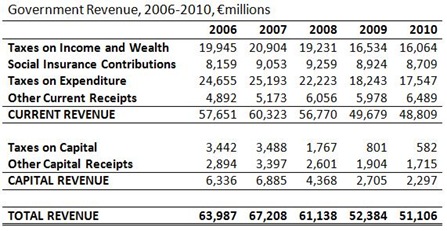
Government revenue in 2010 was 32.8% of GDP and 39.9% of GNP

Since running close to a balanced budget in 2007, expenditure has increased from €68 billion to €70 billion while revenue has fallen from €67 billion to €51 billion.

In 2010, there was an overall deficit of €18.8 billion.  This is expected to fall to around €15 billion this year.  It has been revealed that a “three-year plan” will be published in the autumn giving outline details of how this will be brought down to €5 billion by 2015.

On the expenditure side the largest items are transfer payments and public sector pay.  The capital budget has already been cut by one-half.  The deteriorations on the taxation side are well known as these are  not clouded by the archaic accounting practices used to generate the Exchequer Account.  

The “low-lying fruit” has been picked and the time for the “heavy lifting” is approaching.

Spain Announces Constitutional Amendment on Budget Balance

Spain joins the ranks of countries that are intent on having constitutional-level fiscal rules: the FT article is here.